 Add to Chrome
 Add to Firefox
 Add to Edge
Can Broad Biomedical Knowledge be Contextualized into Scenario-Grounded Propositions?
May 26, 2026
Biomedical discovery often requires connecting broad biomedical knowledge with specific experimental or clinical data. Background knowledge suggests relevant mechanisms but is usually too general to map directly onto dataset variables, while data-driven patterns can be dataset-specific and hard to interpret mechanistically. We study this missing link as knowledge contextualization: transforming broad biomedical knowledge into evidence-supported, scenario-grounded propositions that domain experts can inspect, replay, and validate. We propose SCENE, a bi-level multi-agent framework that treats knowledge contextualization as iterative search. The upper level converts broad knowledge into search directions and grounds them in the dataset schema. The lower level executes these directions through multi-objective optimization to identify concrete propositions that balance evidential strength and data support. Feedback between the two levels progressively refines the search. We evaluate SCENE in two settings: discovering patient subgroups with heterogeneous treatment benefits in clinical trial scenarios, and identifying context-specific biological responses in LINCS L1000 studies. In clinical trials, SCENE discovers specific, well-supported subgroups and outperforms existing baselines. In L1000 studies, SCENE identifies perturbational contexts with strong target-response matching and high positive rates. These results show that SCENE bridges broad knowledge and scenario-specific evidence, producing traceable, inspectable hypotheses for follow-up validation.

Don't Retrain, Just Reuse: Recovering Dual-Target Molecules from Single-Target Diffusion Models
May 25, 2026Designing a single molecule that modulates two targets is a promising strategy for polypharmacology, but it remains substantially harder than standard single-target generation because one candidate must satisfy two binding requirements while preserving drug-likeness and synthesizability. Existing dual-target generative methods typically introduce dual-target capability by either retraining the generator or intervening in the diffusion process during sampling. The former can be costly and difficult to stabilize when dual-target supervision is sparse, while the latter may be sensitive to denoising-time target balancing and competing update directions. These limitations motivate a generator-preserving alternative that keeps the pretrained prior intact: can dual-target candidates instead be recovered from the input space of a frozen single-target diffusion model, without modifying its parameters or denoising dynamics? We formulate this task as a constrained multi-objective optimization problem and propose REUSE, a hierarchical evolutionary input-space search framework that combines pair-conditioned exploration with structured multi-stage selection to enforce dual-target affinity, chemical quality, and diversity. Experiments show that, compared with methods that modify the diffusion process, REUSE consistently improves dual-target affinity and balance, achieving a 20.9-percentage-point gain in Dual High Affinity over the strongest prior baseline while maintaining competitive molecular quality.
MS-CustomNet: Controllable Multi-Subject Customization with Hierarchical Relational Semantics
Mar 22, 2026Diffusion-based text-to-image generation has advanced significantly, yet customizing scenes with multiple distinct subjects while maintaining fine-grained control over their interactions remains challenging. Existing methods often struggle to provide explicit user-defined control over the compositional structure and precise spatial relationships between subjects. To address this, we introduce MS-CustomNet, a novel framework for multi-subject customization. MS-CustomNet allows zero-shot integration of multiple user-provided objects and, crucially, empowers users to explicitly define these hierarchical arrangements and spatial placements within the generated image. Our approach ensures individual subject identity preservation while learning and enacting these user-specified inter-subject compositions. We also present the MSI dataset, derived from COCO, to facilitate training on such complex multi-subject compositions. MS-CustomNet offers enhanced, fine-grained control over multi-subject image generation. Our method achieves a DINO-I score of 0.61 for identity preservation and a YOLO-L score of 0.94 for positional control in multi-subject customization tasks, demonstrating its superior capability in generating high-fidelity images with precise, user-directed multi-subject compositions and spatial control.
ChemBOMAS: Accelerated BO in Chemistry with LLM-Enhanced Multi-Agent System
Sep 10, 2025The efficiency of Bayesian optimization (BO) in chemistry is often hindered by sparse experimental data and complex reaction mechanisms. To overcome these limitations, we introduce ChemBOMAS, a new framework named LLM-Enhanced Multi-Agent System for accelerating BO in chemistry. ChemBOMAS's optimization process is enhanced by LLMs and synergistically employs two strategies: knowledge-driven coarse-grained optimization and data-driven fine-grained optimization. First, in the knowledge-driven coarse-grained optimization stage, LLMs intelligently decompose the vast search space by reasoning over existing chemical knowledge to identify promising candidate regions. Subsequently, in the data-driven fine-grained optimization stage, LLMs enhance the BO process within these candidate regions by generating pseudo-data points, thereby improving data utilization efficiency and accelerating convergence. Benchmark evaluations** further confirm that ChemBOMAS significantly enhances optimization effectiveness and efficiency compared to various BO algorithms. Importantly, the practical utility of ChemBOMAS was validated through wet-lab experiments conducted under pharmaceutical industry protocols, targeting conditional optimization for a previously unreported and challenging chemical reaction. In the wet experiment, ChemBOMAS achieved an optimal objective value of 96%. This was substantially higher than the 15% achieved by domain experts. This real-world success, together with strong performance on benchmark evaluations, highlights ChemBOMAS as a powerful tool to accelerate chemical discovery.
Auto DragGAN: Editing the Generative Image Manifold in an Autoregressive Manner
Jul 26, 2024
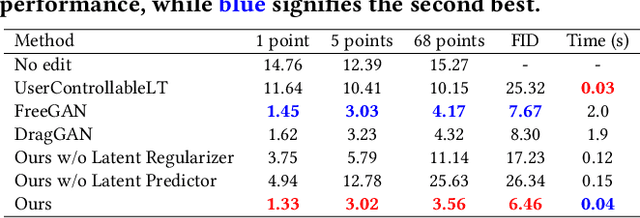

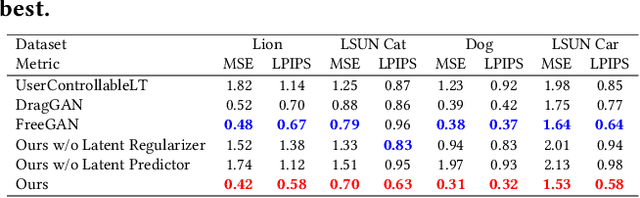
Pixel-level fine-grained image editing remains an open challenge. Previous works fail to achieve an ideal trade-off between control granularity and inference speed. They either fail to achieve pixel-level fine-grained control, or their inference speed requires optimization. To address this, this paper for the first time employs a regression-based network to learn the variation patterns of StyleGAN latent codes during the image dragging process. This method enables pixel-level precision in dragging editing with little time cost. Users can specify handle points and their corresponding target points on any GAN-generated images, and our method will move each handle point to its corresponding target point. Through experimental analysis, we discover that a short movement distance from handle points to target points yields a high-fidelity edited image, as the model only needs to predict the movement of a small portion of pixels. To achieve this, we decompose the entire movement process into multiple sub-processes. Specifically, we develop a transformer encoder-decoder based network named 'Latent Predictor' to predict the latent code motion trajectories from handle points to target points in an autoregressive manner. Moreover, to enhance the prediction stability, we introduce a component named 'Latent Regularizer', aimed at constraining the latent code motion within the distribution of natural images. Extensive experiments demonstrate that our method achieves state-of-the-art (SOTA) inference speed and image editing performance at the pixel-level granularity.
PFDM: Parser-Free Virtual Try-on via Diffusion Model
Feb 05, 2024
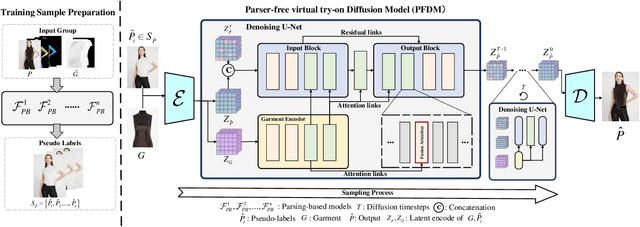
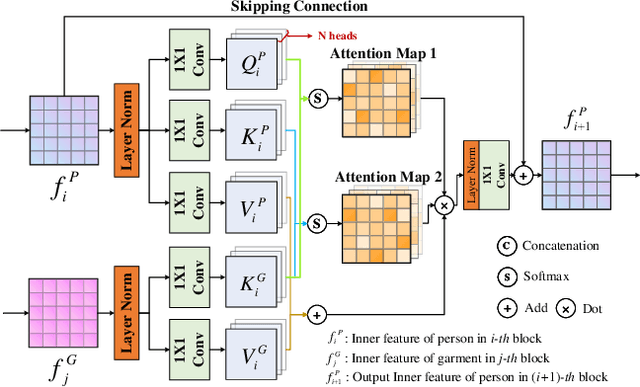

Virtual try-on can significantly improve the garment shopping experiences in both online and in-store scenarios, attracting broad interest in computer vision. However, to achieve high-fidelity try-on performance, most state-of-the-art methods still rely on accurate segmentation masks, which are often produced by near-perfect parsers or manual labeling. To overcome the bottleneck, we propose a parser-free virtual try-on method based on the diffusion model (PFDM). Given two images, PFDM can "wear" garments on the target person seamlessly by implicitly warping without any other information. To learn the model effectively, we synthesize many pseudo-images and construct sample pairs by wearing various garments on persons. Supervised by the large-scale expanded dataset, we fuse the person and garment features using a proposed Garment Fusion Attention (GFA) mechanism. Experiments demonstrate that our proposed PFDM can successfully handle complex cases, synthesize high-fidelity images, and outperform both state-of-the-art parser-free and parser-based models.